
A Beginner's Guide to Sleeping on the Street
The Fine Art of Stealth Camping

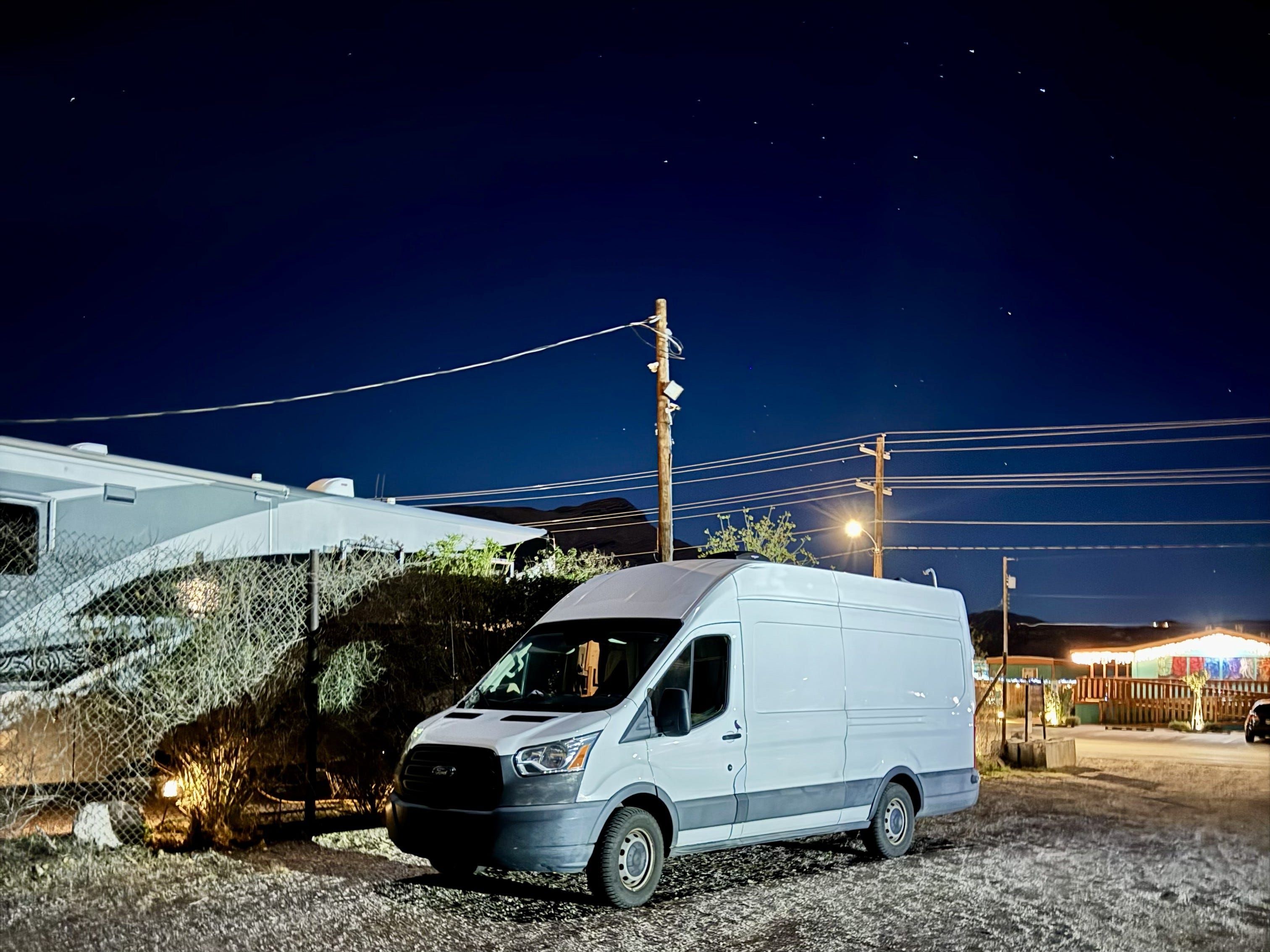
I once spent a week camping on the street in Santa Monica, California where, last I checked, the average rent for a 300 square foot studio apartment was $2500/month. Every night, I nestled into a metered parking space on a few different mixed-use (residential & business) side streets off a main drag. In the mornings, I brewed a cup of coffee in the van and carried my ceramic mug to the ocean, just a few blocks away, where sexy men beat shamanic drums on the beach, and sleek rollerbladers glided down the walking path in fluorescent spandex outfits.
No one seemed to take notice or interest that I was staying in Santa Monica for free. No security officials or cops. No curious residents. They were all too involved in life’s other dramas to question what was up with the dented, white cargo van parked among a hodgepodge of other vehicles on the street. Meanwhile, I was living the Santa Monica life. It felt a bit titillating, a bit mischievous, a bit Robin Hood, to be partaking of the beautiful views and the oceanfront without paying its glittery price tag. Camping on the streets of the beautiful towns and cities not overly polluted by noise, data centers, parking lots, trash, toxins, advertising, and soul-sucking urban sprawl always does. Especially when access to these places is increasingly becoming exclusive province of the ultra-wealthy.
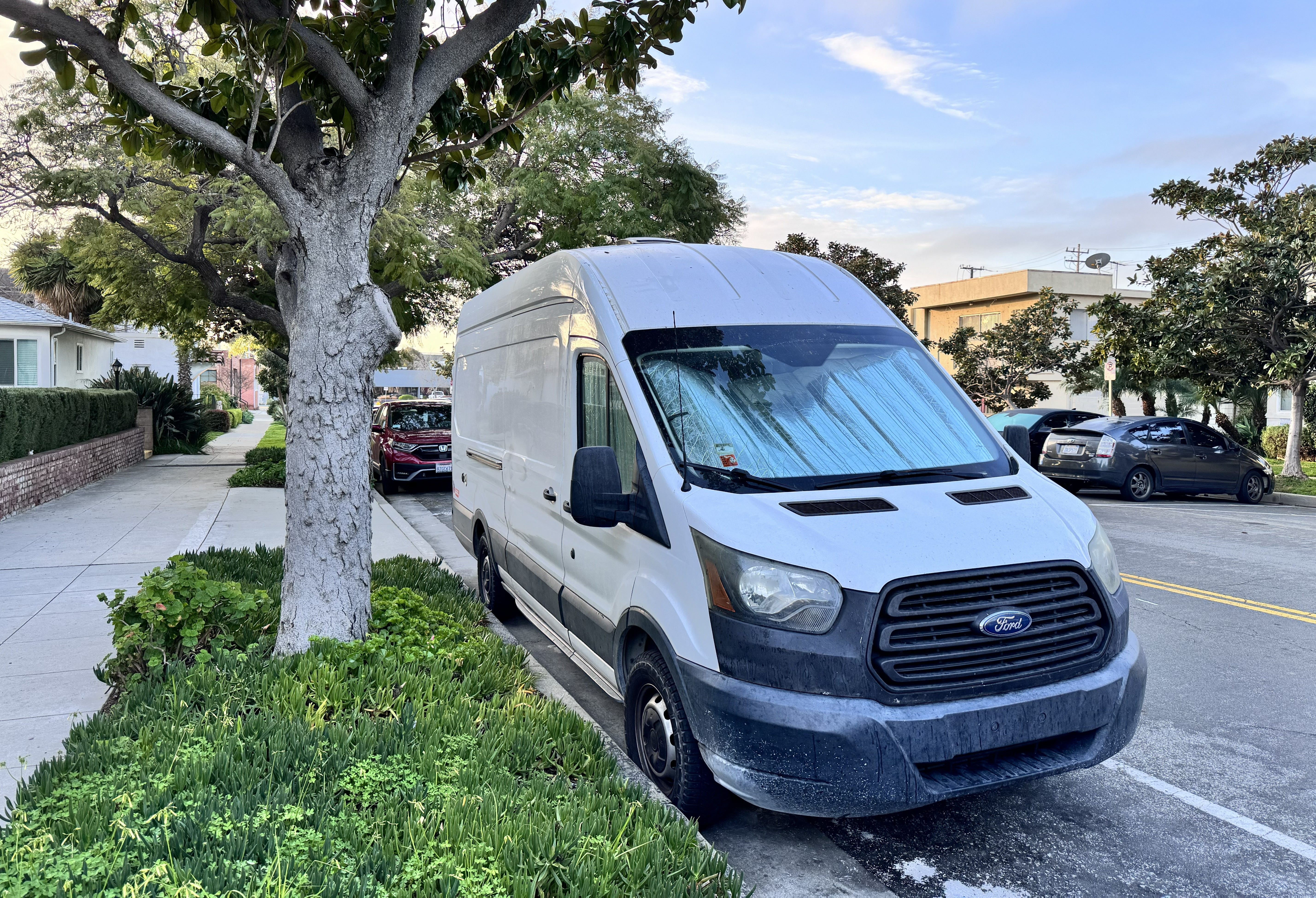
Parking overnight in urban areas, on residential streets, parking lots, and pull-offs is known as “stealth camping.” Essentially, it means keeping a low profile (stealthing) to avoid unwanted attention while parking overnight in public or private spaces not traditionally designated as campsites and that may not be exactly kosher. To be in the public space for any length of time without a clear purpose (read: not participating in capitalism), let alone spending the night in the public space, is vaguely criminalized in most places in the US, or even outright criminalized. But I will get into the legality of this practice later on. Some people live in the public space because they have no other option or choose to live a less financially strained lifestyle. I have camped in the public space as a transient and a wanderer, and that’s the perspective I’m writing from.
Stealth camping always comes with a certain level of risk, but out of the four main options for camping in a vehicle (established campsites, boondocking, privately owned property with permission, and urban/stealth camping), it has definitely taught me the most skills (situational awareness, the art of blending in, and an overall keener sense of observation) and has deepened my experiences of places. More so than would staying in established campgrounds or hotels. There’s a lot to be learned about a place from lingering in its public spaces.
This post is a primer on stealth camping in the US for beginners and the curious: why do it, where to do it, how to do it. It’s the barebones basics I wish that I had had when I started wandering around the American West in my van and was spending tons of money on paid campgrounds and hotel rooms and also limiting my experience of vanlife and my travels around the US.
I’ll be expanding on this topic in much more detail in my forthcoming guidebook, The Ecstatic Wanderer’s Practical and Philosophical Guide to Camping in Your Vehicle, which will cover all four types of overnight options for camping in a vehicle (established campsites, boondocking, private property with permission, and stealth camping) in depth with a list of some of my favorite, secret spots by state. Subscribe below to be alerted when it’s released.
Why Stealth?
First off, there’s the financials. If you’re traveling long-term or living full-time in your vehicle, you’ll quickly learn how expensive paying for campgrounds, airbnbs, or hotels can get, even more than what a monthly rent would be. Not spending money on a campsite becomes a game. Stealth camping is usually free, although sometimes I’ve paid for overnight parking and camped out in the van, like at the LAX airport’s extended lot the night before an early flight. There are other reasons for not spending money besides saving yourself money, which I’ll get to below.
Camping in urban areas gives you greater access to urban amenities and a social life. While it’s possible to make a quick stop in a town to do laundry, take a shower, and get groceries before heading back out to the wilderness, I personally need more time in urban environments than just a day trip to run errands. Stealth camping in a town or city for up to a week or two means joining group activities, hitting the gym, visiting friends, meeting new people, going on dates, browsing shops, and working remotely in an air-conditioned cafe with high-speed internet. In certain towns close to the wilderness like Jackson or Whitefish it’s easier to alternate between nights in town and nights out under the stars on public land. You’ll find your own balance between the wilderness and urban life.
The greatest benefit to stealth camping is that it enriches your travels and can lead to some pretty interesting experiences. Carrying your home on your back like a turtle and staying in the public space is to wander in an Old World style that few experience anymore. The tourism industry has stripped all uncertainty out of travel. A set number of nights in a hotel. Packaged, all-inclusive tours. An airbnb host who pretends to be your local friend, while buffering you from any unpleasantness out of fear for your one-star review. Dancing with uncertainty is real life and where the magic and the meaning of travel is found. How long will you stay in one place? What friends will you make? What gold will you spin from your misfortunes?
As a stealth camper, you inhabit the liminal space of neither tourist nor resident, and more locals respect that than you might think. There’s still an ingrained hospitality toward the wanderer that persists in spite of the tourism industry. When you travel outside of the monetary complex, not treating people’s homes like something to consume, then numerous doors will open for you, not to mention friendships. You will start out in a place stealth camping and end up with invitations to park in people’s driveways, or in the parking lots of local businesses. I’ve experienced it nearly everywhere I’ve gone.
Consider that while you might not be spending money on hotels and campsites, you still owe something to the place where you’re stealthing: your respect, your compassionate observations, your stories and news from the road, your authentic heart, your roving ministry of dreams.
Where to Stealth?
All that being said, living in a vehicle long-term draws both revulsion and wonderment depending on where you are and who you engage with. Let’s just say that the extreme wealth disparity in the US has made certain people more discriminatory and others more curious about non-conformity.
Most places in the American West have felt welcoming towards wanderers and the van class. Bear in mind this is coming from my experience as a white woman. In some states, like California, which is chock full of weather-beaten old hippies who have being doing vanlife since the 1960s; minimalist camper dudes who only need a few joints and a utility knife; and wealthy urbanites with $300K pleasure vans of their own, you’ll find a fairly relaxed attitude towards those who live and camp in vehicles. Although, certain areas like San Francisco are not good places to stealth because of the high crime and recent crackdowns on people living in RVs.
To be clear, I do not advise anyone to break the law. I advise researching the local laws. Some places have regulations, but they’re not really enforced. It’s your call whether or not you take the risk. Cities will have tougher laws than small towns. Small towns are likelier to have folks who take notice (whether they are amenable or not to camping on the street depends). Regulations are not always black and white about sleeping in your vehicle. There are also, what I see personally as valid reasons for risking a stealth camp in a place with regulations against it, such as being too tired to drive safely.
Facebook groups can be helpful forums for asking fellow campers about their experiences in particular places. Be aware that while you may find sound advice in those forums, you’ll also encounter vehement goody two-shoes who write in all caps and use scare tactics but don’t have much stealth experience to back it up. Ultimately, you learn to stealth by stealthing; there’s only so much you can figure out from online searching. That’s why, if possible, I like to do what I call a daytime vibe check.
Start by identifying spots using apps iOverlander, Campedium, The Dyrt, and Sekr. I’m sure there are even more now. iOverlander is my go-to. It’s paid and has user-created entries of places where people have actually parked overnight. Often, campers will include helpful field notes about the vibe, the beauty, the flatness of the street, and details about what they encountered, like police knocking in the middle of the night, or loud road noise early in the morning. My caution with using the apps is that so many people use them,that you can bet the listed spots have been frequented by other campers, which will probably have attracted some notice (“Why are there always hippie vans parked outside my house??” a resident may wonder). Or you may roll up and find another camper already in the spot, as happened to me recently in Durango on a daytime vibe check. I ended up parking that night a few blocks away on a side street near a church.
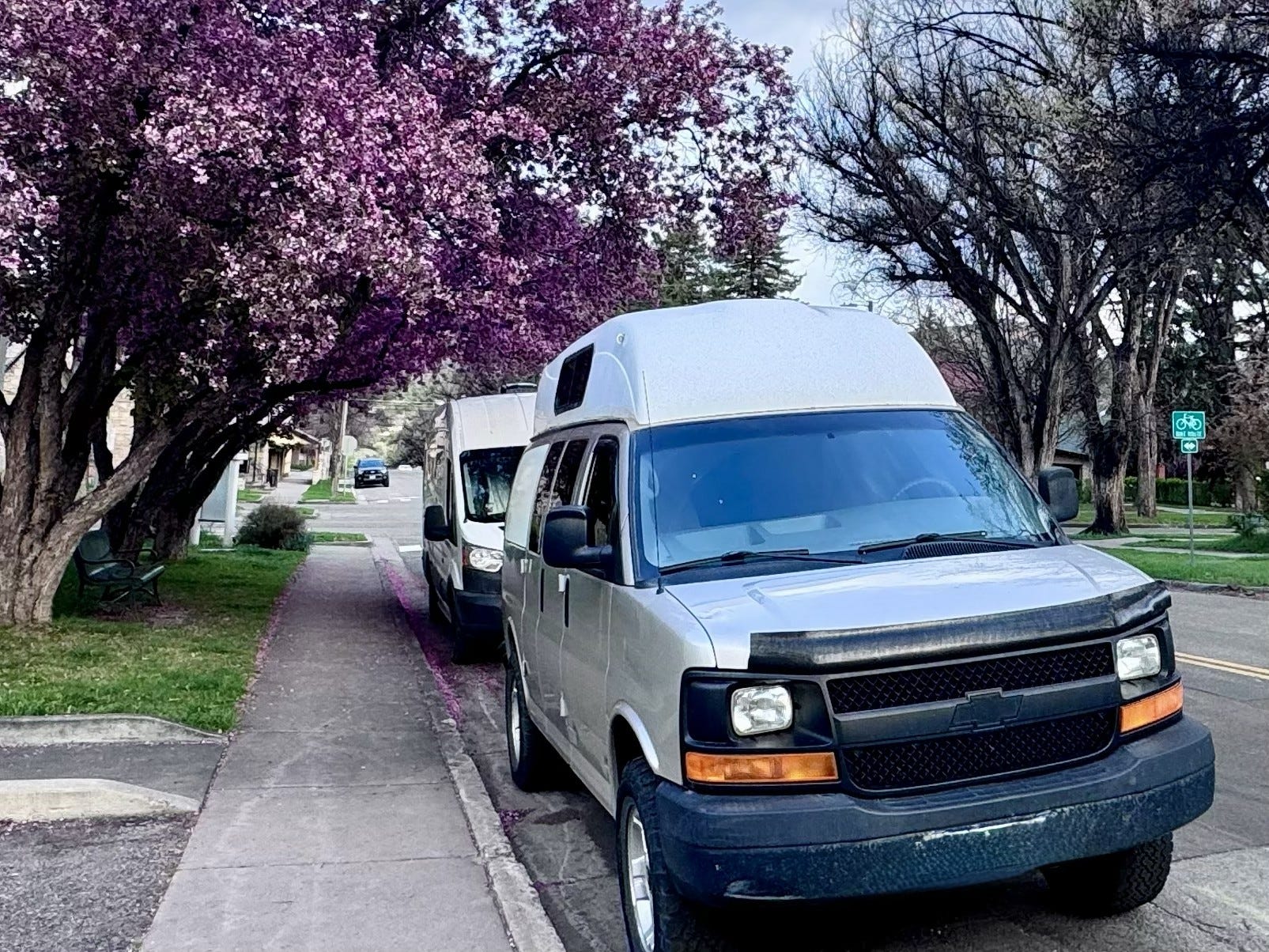
The next thing to do is ask local, trustworthy sources. Once, in a small Colorado ski town, I asked a few shopkeeps and baristas about parking overnight in the downtown area.
“All of us live in vans, dude,” one said. “No one can afford the rent. Don’t worry, no one is gonna bother you.”
That was great information and made me feel safer about parking in that town overnight.
It helps to have some common sense about who to ask about the overnight parking situation. Ask young people who work in the service industry, for example, and not, say, a stuffy looking lady exiting a Mormon church, or a sketchy dude in a bar who’s trying to pick you up. If you find a trustworthy source of information, you can also ask their suggestions for where to park. Make sure the person is trustworthy, because we don’t let random people know where we’re staying overnight.
Check out the spot during the day, so you’re not stuck late at night when you discover that the spot makes you uncomfortable. Always have a plan b and a plan c. The more you stealth camp, the easier this will get. In beginning, the logistics and hyper-vigilance will take up a lot of your energy. In addition to feeling an intuitive sense and a common sense level of safety, the spot needs to be flat. Identify comparable spots nearby in case someone takes that particular stretch of street by the time you show up later. Choose a side street, not a main road. That’s for safety, keeping a low profile, and avoiding a noisy night.
If I don’t know a town or city well, I start off with libraries after closing hours or church parking lots in neighborhoods that are low crime (I go for Episcopalians because they’re progressive and value beauty, so their grounds tend to be much more aesthetic than other denominations). You can ask permission if someone is around. That’s always a smart practice, even just for safety. I’ve never had an Episcopalian tell me no or expect me to attend services. Ask permission when you’re just starting out. After you have some experience, you can ask forgiveness. A librarian might be more inclined to say no, and then you won’t be able to camp there.
Other options that are good for beginners are hospital parking lots where people are coming and going 24/7, or the businesses that you’ve already patronized. I once had a delicious meal at a farm-to-table restaurant and winery in a small town in Washington state. The bartender said, “If you park in that back employee lot, I think you’ll be fine, but you didn’t hear that from me!”
How to Stealth? (AKA The art of blending in)
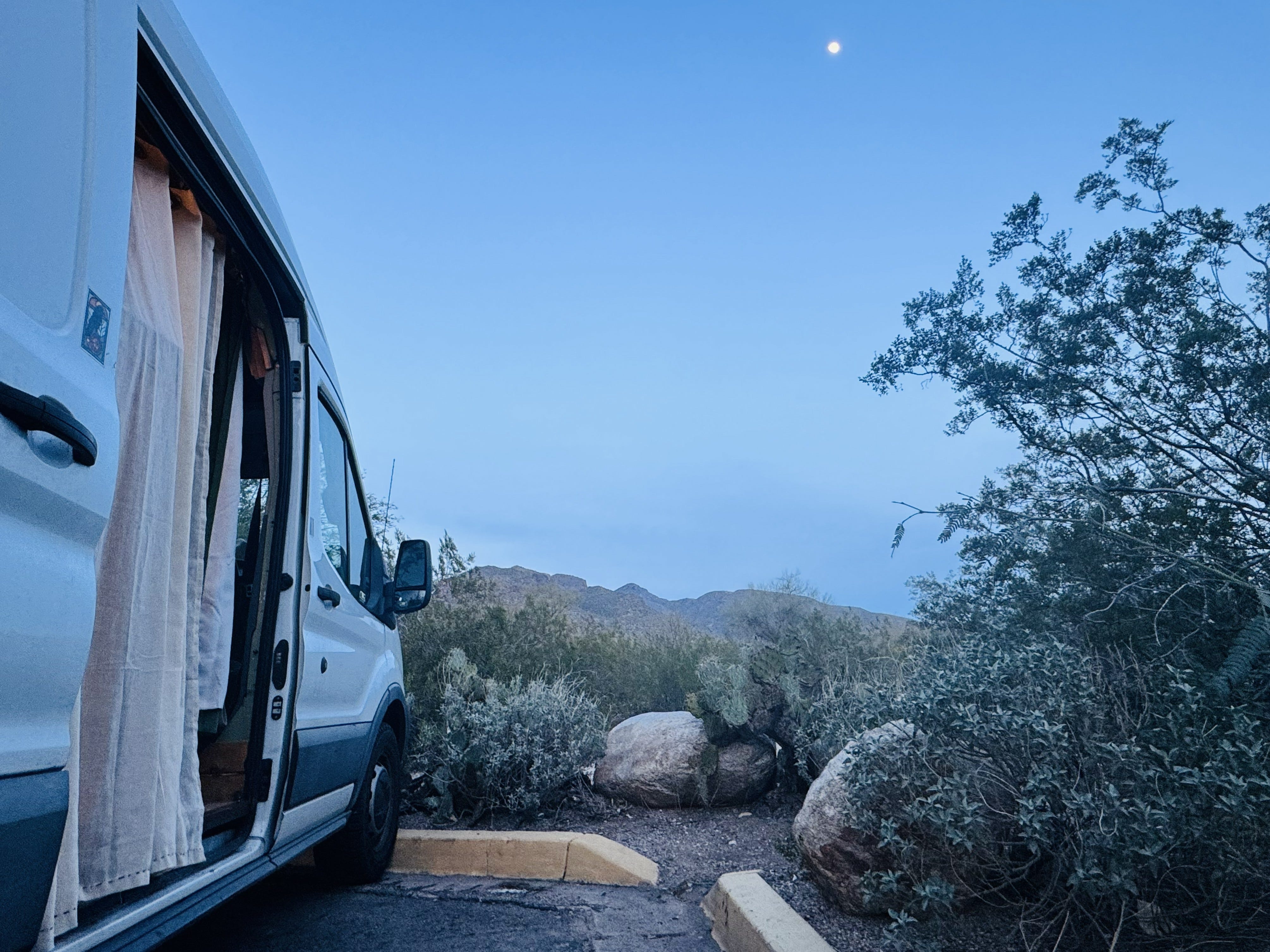
The thing you want to avoid that you will hear vanlifers mention a thousand times, is the fabled knock in the middle of the night. In five years, I’ve only had two knocks. One was from a security guard at the Madonna Inn in San Luis Obispo (do not park here overnight!) and the other from two cops who rolled into a church parking lot in Tucson for a rendezvous and spotted me backed into a distance spot near the dumpster. Both times they offered me suggestions of other places to park and left it at that. The first was a rookie mistake on my part. Never camp at a boutique hotel or place that likely has a 24-hour security guard. The second knock was just bad timing, but also happened early in the evening, and I was caught unawares, puttering in the van making tea with the lights on and the side door open.
The fine art of stealth camping is really the art of blending in and avoiding notice, which I realize, sounds shady, because it’s a skill particular to spies and fugitives. But it’s also particular to octopuses, owls, chameleons, and hobbits, which is why Gandalf thought they’d stand a good chance of casting the one ring into the fires of Mount Doom. There’s a lot of richness to ponder in cultivating the skill of invisibility. One thing you may find interesting in your stealth camping journey, as I have, is to notice that not many people take much notice.
I could wax poetic on this topic for pages and pages, but I’ll save that for the memoir.
Most people, unless they’re cops or security guards who get paid to be on the lookout, dash through life barely aware of the public spaces they inhabit. If you take even the most minimal precautions not to stand out, it’s likely that no one will know you were there.
I want you to be a ninja, not Jacques Closeau from the Pink Panther. Let me explain. I see some youtubers putting a lot of ridiculous effort into disguising their vans so they look like commercial vehicles and not vagabond wagons. They put hardhats on the dash and hang bright, orange vests on the passenger seat. Some people even put fake business decals on the side. This is such an amateur, over-the-top tactic akin to Closeau dressing up like a pirate and waddling out on the wharves to glean information about a murder. If you have a ventilation system on top of your vehicle like a MaxxAir fan or an a/c unit, or shore power plug on the side, you’re not fooling anyone.
Consider, instead, the ninja, who yes, also used disguises, but had a more refined and subtle sense of moving through the world undetected. The ninja lived by the philosophy that you cannot catch what you cannot see, and you cannot see what does not disturb your autopilot. There’s an art to stealth camping, and you learn it by noticing what goes on in the public space yourself. What sticks out? What blends in? It’s helpful to start seeing it this way. Otherwise, you’ll be forever reliant on other people’s postings on iOverlander.
To be a little less esoteric and more concretely helpful, I will leave you with some practicable tips.
My best stealth & safety practices:
Back into a spot so you can leave easily if necessary. I don’t always do this, especially if I know a place well, but I should.
Do not put up reflectix visors or other overt window coverings in the windshield. This is a major tell that someone is sleeping in a vehicle and not just parking it on the street while they visit a friend in the neighborhood. I use a blackout curtain that extends behind the front seat for privacy and use magnets to pin the sides so there’s no sliver for anyone to peek inside the back of the van. If you’re camping in a car or van that has windows in the back, use black window coverings.
Arrive late (9 or 10pm is usually fine) with teeth brushed and face washed so that all you are doing is jumping into bed.
Use inside lights prudently. I take a kindle into bed and that’s about it.
Find the right blend of a lighted area that it deters thieves but not so well lit that it draws attention.
Look for a spot where enough people would be within close earshot (like a residential area), but there’s not a lot of road traffic.
Always know your exits and keep your keys in the same place.
Never park in the same spot two nights in a row.
If you found this information helpful, or have other thoughts, questions, or opinions on the practice of stealth camping, let me know in the comments.
Subscribe to the Ecstatic Wanderer for personal letters and practical advice on the art of wandering and meaningful travel, informed by lived, human experience. Written by a weird, messy, brilliant brain-and-heart team known as April Isaacs, never AI.
Another Guide to the Art of Wandering That You Might Enjoy…
One spot that doesn't get enough attention, I think, is big 24-hour truckstops like Flying J or Love's Travel Centers. They have TONS of people coming through, and a lot of them stop for eight hours at time, there are cameras everywhere, and I generally feel quite secure there. As a bonus, if you wake up when the place is reasonably busy, you can ask around for a trucker's shower pass, and someone will always give you one. (Truckers tend to amass more than they can use.) And truck stop showers are AMAZING. I've never had one that didn't have great pressure, clean towels, and a heated interior. It's the experience of a hotel for only $15 or so. Sometimes I even pay for it.
The downside is that they're fairly busy and you do hear people come and go. But if you're like me and find the sounds of a city soothing, it's a really good option.
CANNOT WAIT for your book! <3 <3 <3
Love this article April! We “stealthed” for a week in Vancouver, BC last summer and it was a wonderful experience. There was a dog park across the street, a good coffee shop just down the block, and Kitsilano Beach a short drive away which is where we spent our days!